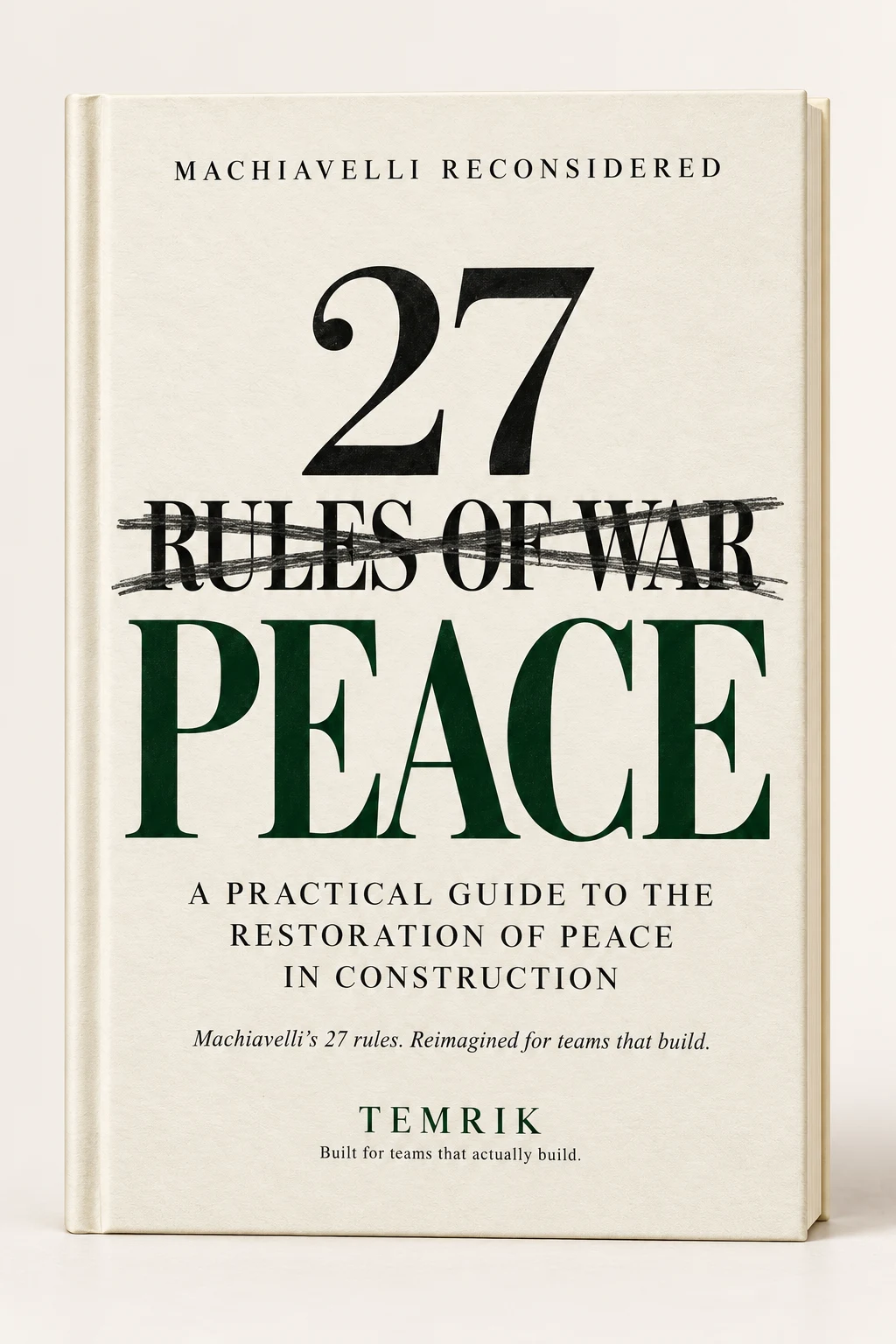
The building does not care who wins the argument. It still needs the drawing resolved, the steel delivered and the subcontractor paid enough to return on Monday.
That is the uncomfortable starting point for a review of 27 Rules of Peace, TEMRIK’s construction guide built around a reversal of Machiavelli’s rules of war. The question is not whether builders should become nicer. It is whether we can stop organising projects in ways that make conflict predictable, then act surprised when the correspondence turns hostile.
My view is that peace belongs in the management system. It needs procedures, owners and timely decisions. AI makes that proposition more practical, but only if the system helps people confront the awkward facts rather than generate more polished excuses.
The dispute usually starts before the first accusation
Construction disputes are complicated because several different questions become entangled. What happened? What did the contract require? Who could authorise the change? Did it affect completion? What did it cost? What evidence supports the answer? Two people can agree that work changed and still disagree, legitimately, about every other question.
Contracts divide responsibility into packages. Construction joins those packages back together on a physical site. The gap between those two arrangements is where trouble accumulates.
| The handover | The slippage | The useful intervention |
|---|---|---|
| Design to instruction | A revised drawing circulates without clarity about approval or changed scope. | Link revision, authority and affected packages before release. |
| Instruction to valuation | Work proceeds while each side assumes a different price or entitlement. | Record the instruction, required notices, valuation status and unresolved points. |
| Programme to procurement | An order is treated as a confirmed delivery despite missing deposits or dimensions. | Track each condition and the installation dependency separately. |
| Warning to decision | An issue is discussed repeatedly but nobody owns the next answer. | Name the approver and the last useful decision date. |
| Progress to payment | Physical completion, evidence, assessment and cash timing are confused. | Reconcile what was done, claimed, assessed, disputed and paid. |
| Agreement to implementation | A handshake resolves the number but leaves time, releases or signatures unclear. | Record precisely what was settled and verify the resulting actions. |
Delay then changes the problem. A late approval can miss a manufacturing slot; the missed slot alters installation; the new sequence affects another trade. By the time people argue about one event, they are often pricing a chain of consequences.
The National Audit Office’s 2019 review of Crossrail identified a compressed schedule, contractual arrangements and the absence of a realistic plan among the factors driving unnecessary cost. That is evidence about that programme, not proof that an AI tool would have saved it. The transferable lesson is narrower: reported confidence must be tested against the work and decisions still outstanding.
Who benefits when a project becomes a fight?
“Fighting only makes the lawyers rich” captures a real frustration. It is also too simple to explain a real dispute. Good legal advice can preserve an entitlement, prevent an unlawful step or bring an unproductive argument to an end. Avoiding advice until positions have hardened can be a false economy.
What changes in a prolonged fight is where the money and attention go. Solicitors, counsel, experts, claims consultants and dispute administrators may earn fees from resolving the conflict. Depending on the funding arrangements, financiers may receive interest while capital remains tied up. Those receipts are not the same as unjustified profits, and they do not establish that anyone wanted the dispute.
A party may also gain tactical advantage from delay if its opponent needs cash sooner. That is a possible incentive, not an allegation about a named company. The danger is a process in which endurance starts to matter more than the delivery problem that needed solving.
Meanwhile, the project pays in less visible ways: directors reconstruct old decisions; estimators become witnesses; supervisors search messages instead of supervising. A recovery may be justified and worth pursuing. It still does not refund every hour of attention diverted from the next job.
The management question is therefore not simply, “Can we win?” It is, “Which available course protects our rights and produces the best defensible outcome from here?” Peace can include firm notices, stopping unsafe work and legal proceedings. It does not mean surrender.
A review of the book: preparation with consequences
27 Rules of Peace follows 27 historical rules, then retains, redirects or rejects their assumptions for construction. The military headings are TEMRIK paraphrases; the construction principles are modern interpretations, not advice Machiavelli wrote for project managers.
The strongest part is the recurring move from principle to procedure. Each chapter supplies an execution structure covering a trigger, inputs, checks, AI assistance, exceptions, human decision, action, retained evidence, escalation and output. The 109-page guide also includes six appellate cases, public-audit material, conflict economics and a Peace Audit.
Its limitation is equally important. This is a proposed operating approach informed by documented experience, not a controlled study demonstrating that the 27 playbooks reduce dispute rates. Some principles overlap, and reading all 27 in sequence is less useful than taking the one that matches a current project problem and testing its procedure. The historical framing earns its place when it challenges adversarial habits; it should never distract from the practical work.
Here is the chapter-by-chapter reading guide. The headings follow the book’s peace principles; the short summaries are my editorial interpretation.
CHAPTER 01Protect the outcome you both depend on
A negotiating gain can damage the access, sequence or supplier capacity both parties need. Test the effect on the whole project before celebrating a local saving.
CHAPTER 02Watch the project, not for an enemy
Repeated unanswered queries and moving delivery dates deserve attention together. Monitor the developing constraint, assign a response and resist turning colleagues into surveillance targets.
CHAPTER 03Mobilise on evidence, not confidence
A booked pour is not proof of readiness. Confirm drawings, access, inspections, people and authority before the cost of mobilisation pressures everyone to proceed.
CHAPTER 04Do not finance leverage by starving delivery
Separate disputed valuation from the wider payment position. Using an entire account as leverage can weaken the very trade needed to complete the work; the applicable payment procedure still governs.
CHAPTER 05Give people time to respond
A late instruction destroys options. Communicate known changes and uncertainties early through the correct channel, without pretending that a warning is an agreed price or an authorised variation.
CHAPTER 06Treat decision windows as project assets
The last useful decision date may arrive before the formal deadline. Protect fabrication slots, access opportunities and alternative sequences while they still exist.
CHAPTER 07Make the right response familiar
Rehearse the actual workflow: record an instruction, check authority, notify and follow up. A policy in a folder is much less useful than a supervisor who has practised the task.
CHAPTER 08Let the process carry the disagreement
An angry email needs a factual response, not a competing performance. Separate evidence, interpretation, immediate obligations and the proper route for deciding the issue.
CHAPTER 09Make handovers lawful, complete and fair
Transfer the reasoning behind decisions as well as the files. Preserve continuity without inviting departing staff or new recruits to misuse another organisation’s confidential information.
CHAPTER 10Do not commit every resource twice
Float, cash and backup staff cannot be promised to several simultaneous problems. A real reserve has an owner, availability and conditions for release.
CHAPTER 11Test capability before reliance
A qualified business can still be overstretched. Check available people and delivery capacity on both sides, including your own ability to review and approve the work.
CHAPTER 12More people cannot repair a blocked workface
Extra labour cannot solve missing access or unresolved design. Establish the constraint before buying acceleration that may simply produce congestion.
CHAPTER 13Make uncertainty small enough to learn from
Use a trial installation or limited pilot with acceptance criteria before repeating an unfamiliar detail. Otherwise, uncertainty gets built into the project faster than anyone can investigate it.
CHAPTER 14A win is unfinished until it is implemented
An agreement in principle needs signatures, scope, payment and time consequences recorded. Relief after negotiation is precisely when a second disagreement can be planted.
CHAPTER 15A project cannot build with promises alone
An order is not a delivery. Track approvals, deposits, production, dispatch and receipt separately so the programme does not rely on materials that are only nominally secured.
CHAPTER 16Do not make the site fit an untested assumption
Check delivery hours, access, neighbours, lifting and laydown against the proposed method. A generic tender assumption can become a very specific argument after award.
CHAPTER 17Verify identity and authority without suspicion
Knowing someone is not evidence that they can vary scope. Keep identity, access permissions and delegated approval limits distinct and current.
CHAPTER 18Be predictable in process, adaptable in method
Revise plans when evidence changes and preserve the history. Keeping an impossible baseline while everyone improvises creates competing versions of the project.
CHAPTER 19Separate participation from decision authority
Consult the people who understand the work and identify the person entitled to approve it. Meeting attendance and apparent consensus are not substitutes for authority.
CHAPTER 20Reward early truth, not reassuring reports
People conceal uncertainty when bad news attracts humiliation. Management must make early warnings useful to raise, then demonstrate that reporting leads to a fair response.
CHAPTER 21Measure the war before entering it
Assess fees, cash timing, management effort and delivery consequences alongside the claim value. Sometimes proceedings are necessary; choosing them should still be a considered decision.
CHAPTER 22Continuity should not depend on one line holding
A named backup is not a working fallback. Ensure the replacement has the records, rights, resources and delegated authority needed to receive the responsibility.
CHAPTER 23Do not move an obligation without its dependencies
When a trade is asked to help another package, settle the scope, supervision, design responsibility and payment route. Those obligations do not transfer automatically with a verbal request.
CHAPTER 24Think ahead while there is still time to choose
Rehearse a foreseeable disruption and identify the first action and approver. A risk register becomes practical when the team knows what it will do when the trigger occurs.
CHAPTER 25A funded plan still needs people who can deliver it
Budget approval cannot conjure a specialist or make unsuitable equipment work. Test whether cash, skills, materials and sequence are available together.
CHAPTER 26Do not leave a sound project unable to explain itself
Preserve the instruction, event, valuation and decision while they are current. Building a chronology from scattered phones after a dispute starts is an expensive substitute.
CHAPTER 27Make the system lighter, not the people’s lives harder
Remove duplicated reporting that serves no decision. Simplification should protect useful evidence and welfare, rather than dressing up cuts to essential controls as efficiency.
From a passive manual to an active management system
A conventional procedure waits for someone to remember it. An agent-assisted playbook can start when something changes: a drawing arrives, a delivery moves, a meeting closes or a valuation remains unanswered. That is the important opportunity. Experience becomes an instruction the system can apply at the point where it matters.
Consider an illustrative case. A revised detail arrives after a subcontractor has ordered material. A useful agent would identify the revision, retrieve the relevant instruction and notice provisions, locate the order, ask what has already been committed and prepare an exception for the commercial manager. It would distinguish verified facts from missing information. It would not decide, on its own, that the client owes money.
The manager then decides who should respond, what must be clarified and which authorised communication is needed. The system tracks the decision, its deadline and the evidence of completion. If no response arrives before the installation option disappears, it escalates. That is active administration: the issue continues to have an owner after the meeting ends.
The six public construction playbooks I have published on GitHub cover contract review before signature, variation control, payment evidence, meeting decisions and actions, delay early warning, and dispute prevention. They are downloadable Markdown instructions for adaptation in an agent, not a software installation or a guarantee of compliance.
A command such as “identify the latest authorised instruction and list the unresolved evidence” gives an agent a useful task. “Resolve this dispute” gives it an invitation to overreach. Good playbooks specify the source records, checks, stopping conditions and human approval needed before any outward action.
Lessons from other projects are valuable precisely because your team should not have to repeat every expensive mistake. But a lesson is not automatically a proven intervention. A court decision turns on particular facts and wording; an audit reveals a particular delivery history. Turn the lesson into a proposed control, test it against your own contract and measure whether it helps.
What a command centre should actually control
The ambition behind tools such as the TEMRIK Command Centre is compelling: connect project information, responsibilities and approval workflows so a playbook becomes part of how the business operates. The potentially transformative step is making these checks repeatable across everyday documents, rather than relying on a senior person to notice everything.
That is a direction for configured implementation, not a claim that every workflow in the book is a ready-made TEMRIK feature. The useful system must connect to the right records, enforce permissions outside the prompt, route consequential decisions to authorised people and preserve a reviewable history. Availability and integrations need to be established for each deployment.
Nor is it credible to call this the first software ever to manage project risk. Existing construction platforms already connect records and workflows. The new opportunity is to make language-rich procedures more accessible to software agents and managers, with controlled assistance across the messy documents where project knowledge lives.
IBM’s AI consulting services provide useful wider context: strategy, data, architecture, security and governance belong in the same implementation conversation. Autodesk’s construction AI software overview provides an established construction-sector comparison for embedding assistance in everyday workflows. These are relevant external resources, not endorsements of TEMRIK or this review.
The NIST AI Risk Management Framework offers a voluntary framework for managing AI risks. In practice, a project should test wrong revisions, missing evidence, contradictory instructions and unavailable approvers as well as the easy case. A persuasive draft based on the wrong document can accelerate the very dispute the system was supposed to help avoid.
Our earlier editorial on why agents need experienced AI advisers makes the companion point: making an action easy to execute does not establish that it is authorised or commercially sensible.
A global problem needs local playbooks
The coordination problem is recognisable in Sydney, London or Barcelona: people need to know what changed, who can decide and when action is required. TEMRIK presents a global brand and a shared control approach to that problem. Its regional entry points are TEMRIK Australia, TEMRIK global, including European enquiries, and TEMRIK UK.
The domains are entry points, not evidence that three separately validated legal playbook libraries exist. The published guide shares principles; an operational playbook must be adapted to the actual jurisdiction, governing law, contract form, language, notice requirements, payment process, privacy obligations and delegated authority. Europe is not one construction-law jurisdiction, and Australia and the UK also require care about local application.
Keep the principle consistent: surface the uncertainty, preserve the record, get the right person to decide. Configure the procedure locally. A copied deadline from another country is not efficiency.
The verdict: use the book at the next difficult handover
This is a useful field guide when read with a project on the desk. Its value is not that 27 rules make conflict disappear. It is that they make familiar failures of preparation harder to excuse.
Start with one unresolved instruction, payment issue or procurement dependency. Use the relevant playbook to establish the facts, identify the decision and give it an owner. Judge the result by whether the team reaches a usable answer sooner, with less reconstruction and a better record. Count reopened issues and unnecessary alerts too; a busier system is not necessarily a better one.
We will still disagree about construction. Sometimes we will need a tribunal, adjudicator or court. But the industry should not keep mistaking avoidable administrative drift for an unavoidable cost of building.
More building. Less fighting. Put the procedure for peace to work before the argument takes over.
FREE EBOOK · 109 PAGES
27 Rules of Peace
A practical guide to preparation, evidence and controlled disagreement in construction, with six public agent playbooks.
Get your free copy on TEMRIK (opens in a new tab)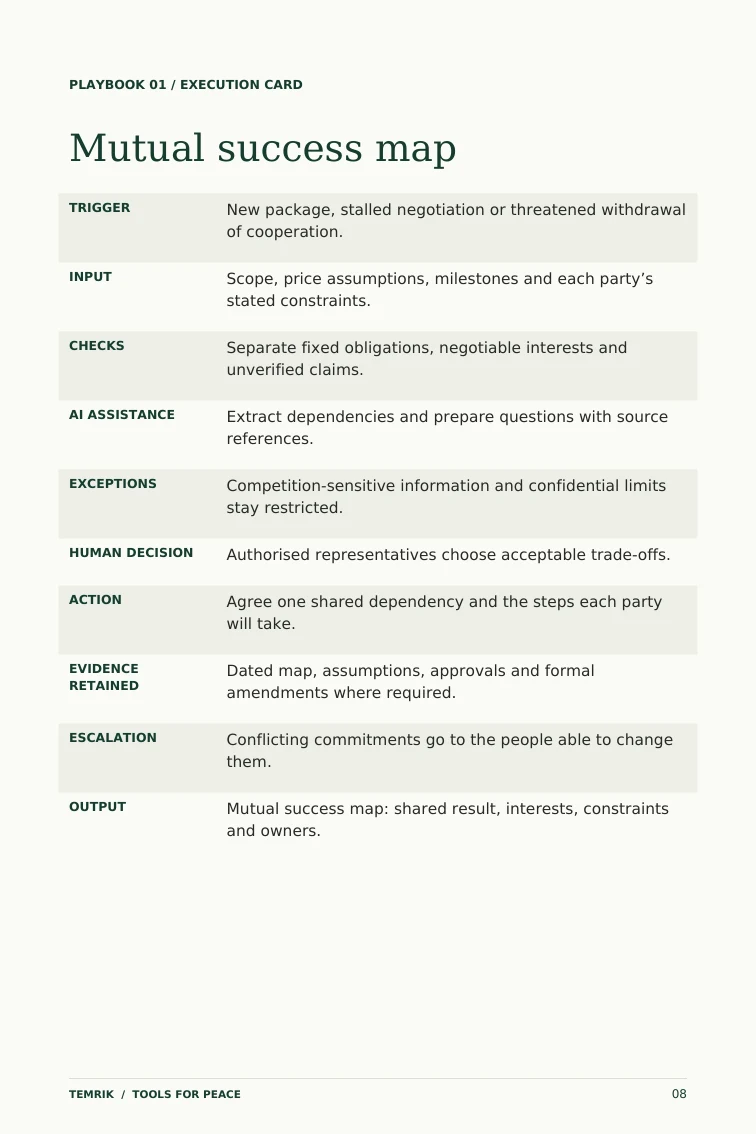
Editorial and book review by Daniel Roberts. The author has published the linked public playbook repository; this is an opinion piece, not an independent product test. Chapter headings and summaries refer to the 109-page TEMRIK Peace edition reviewed on 25 September 2026. The worked scenario is illustrative. No measured reduction in disputes or independently verified product outcome is asserted.
General management commentary. Obtain appropriately qualified advice for live contractual, legal, safety and financial decisions. External links are selected for relevance; no search-ranking position or endorsement is claimed.